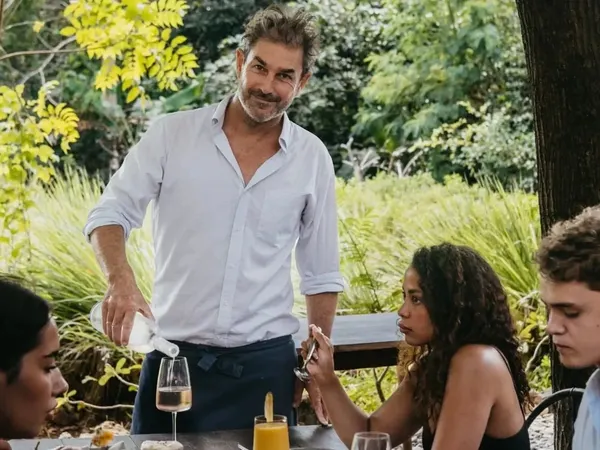
Yuda Bustara is the kind of chef everyone in this industry already knows and nobody can quite summarise. A TV host, a YouTube pioneer, a private chef, a brand-builder, and, as of 2024, the winner of a Netflix cooking competition. When we spoke, Bangkok on his side of the screen and Bali on mine, I asked him to start at the beginning.
Two kitchens
He didn't grow up around hospitality. His father was a pilot; his mother once worked in a hotel. What shaped him was stranger than a family restaurant: his dad went vegan about twenty-five years ago. His mother cooked for his father. So the home ran two separate kitchens.
Which meant that if young Yuda wanted meat, he had to cook it himself. "That's why I cook," he tells me. His mother's response was essentially: fine, you can cook, so go do hospitality. He watched Siska Soewitomo and Rudy Choiruddin instead of cartoons, then Jamie Oliver and Gordon Ramsay, then left for Taylor's in Malaysia. The loop would eventually have him cooking alongside the very people he'd grown up watching.
Getting sick of cooking
After Malaysia he worked everywhere: kitchens in Singapore, Melbourne, a casino, a hotel, and then he burned out. He went home to Jakarta and told his parents he didn't want to cook anymore.
So he taught. Kids' classes, cooking demos, recipes for magazines. A cooking show followed, Urban Cook, which the Asian Food Network picked up and turned him from a Jakarta face into a Southeast Asian one. Then the brands, the pop-ups, the products with Unilever and Nestlé, the years hosting Iron Chef Indonesia. "I was the face of Indonesian food scene," he says, not a boast, just chronology. "When you search any kind of recipes, my name will come up first." He was early to YouTube, back when the only people watching were the ones who genuinely wanted to be taught something.
You don't have to own a restaurant
The line that reframes everything came quietly. "I realized that you don't have to own a restaurant to be a chef," he says. "You don't have to stuck in one restaurant."
"I realized that you don't have to own a restaurant to be a chef."
His whole career is the argument. One week he's cooking for one of the richest families in the region, who, plot twist, just want fried rice at home. The next he's in a paddy field in Medan or Surabaya as the ambassador for Alfamart and Indomaret, teaching mothers to make dinner from minimart ingredients. He can do both, and most trained chefs can't.
"Sometimes my professional chefs in restaurants in Jakarta," he says, the World's 50 Best kind, "suddenly I give a job to Alfamart's mothers. They're like, speechless." Should I cook truffle at the minimart? There's no truffle at the minimart.
Saying yes, knowing when to say no
This is entrepreneurship dressed as cooking, and he only works with brands he actually uses. He grew up on Buavita, so recipes on the label was an easy yes. "Just make sure every brand that you work, you love it." And he'll say no, to alcohol, to anything that doesn't sit right, even when the money is good, because "when you're building followers, you're building trust to people as well."
He credits the discipline to patience: "I start from nothing as well. I'm not coming from a rich family. So I built the brand myself."
Read the room
"As a chef, you have to read the rooms."
Ask him what actually matters and he doesn't say technique. "As a chef, you have to read the rooms." If a guest is allergic to shrimp and you serve them lobster because it's on your menu, that's not intuition, that's ignoring the elephant in the room. Different clients every week: halal only, private dinners, billionaires who want something simple. "You're doing hospitality from the heart," he says. "Not just making money." And then the line I keep coming back to: "If we're Indonesian, we're born with that. We're raised like that. You just want to cater."
"The problem is communication," he says. Also lot of chefs cook beautifully and freeze the second a camera appears. He learned to speak partly because he served as an Abang, a Jakarta tourism ambassador, and had to.
Maverick, Michelin, and Bangkok
Two years ago, the moving stopped being metaphorical. He was cast for The Maverick Academy, the pan-Asian cooking competition on Netflix created by three-Michelin-star "Demon Chef" Alvin Leung, and he won it. The prize sent him to Hong Kong to cook at LUMA with Leung's team, learning inside a Michelin kitchen after years of celebrity-chef work back home.
When the residency ended he didn't return to Jakarta; a sponsor in Bangkok arranged a visa, and he's been based there since, running workshops, cooking classes, and consulting across Asia as a self-styled culinary diplomat for Indonesia. At Wonderfruit in December he led a hands-on jamu workshop built around Indonesia's old herbal elixirs: roots, spices, and tropical fruit.
What Yuda builds next
So will he open a restaurant? "One day," he says, "I will." Just not now, he likes moving too much. What he's building instead is small and Indonesian and self-sustaining: packaged products with local UMKM producers in Bandung, chicken essence for the halal and gym crowd, things that stand on their own without him showing up every day.
Yuda Bustara spent fifteen years proving you can be a chef without a restaurant, an icon without a fixed address. If you're an Indonesian cook waiting for permission to be more than the kitchen you're standing in, this is it. He already did it. He just forgot to make a big deal of it.
Yuda Bustara is an Indonesian chef, TV host, and culinary entrepreneur, and the inaugural winner of Netflix's The Maverick Academy (2024), the pan-Asian competition created by three-Michelin-star "Demon Chef" Alvin Leung. His prize was a residency at LUMA in Hong Kong, cooking a pan-Asian menu with Leung's team. He studied hospitality and tourism at Taylor's in Malaysia, hosted Iron Chef Indonesia, built one of Indonesia's earliest food-focused YouTube followings, and has worked with brands including Nestlé, Unilever, Buavita, and Quaker Oats. Now based in Bangkok, he works as a Culinary Diplomat for Indonesia. Web: yudabustara.com
Frequently Asked Questions
Who is Yuda Bustara?
Yuda Bustara is an Indonesian chef, TV host and culinary entrepreneur, widely known as one of the earliest faces of Indonesia's online food scene. He has hosted Iron Chef Indonesia, built one of the country's first food-focused YouTube followings, and worked with brands including Nestlé, Unilever, Buavita and Quaker Oats.
Did Yuda Bustara win a Netflix cooking show?
Yes — Yuda Bustara was the inaugural winner of The Maverick Academy, the pan-Asian cooking competition on Netflix created by three-Michelin-star "Demon Chef" Alvin Leung. His prize was a residency at LUMA in Hong Kong, cooking a pan-Asian menu with Leung's team.
Where is Yuda Bustara based now?
After his residency in Hong Kong, Yuda relocated to Bangkok, where a sponsor arranged his visa. He is now based there, running workshops, cooking classes and consulting across Asia as a self-styled Culinary Diplomat for Indonesia.
Does Yuda Bustara own a restaurant?
No — a central idea of his career is that you don't have to own a restaurant to be a chef. He says he may open one "one day," but for now is focused on packaged products with local Indonesian UMKM producers, including a chicken essence aimed at the halal and gym market.
What is The Maverick Academy?
The Maverick Academy is a pan-Asian cooking competition on Netflix created by three-Michelin-star chef Alvin Leung, known as the "Demon Chef." Yuda Bustara won its inaugural season in 2024, earning a cooking residency at Leung's LUMA in Hong Kong.