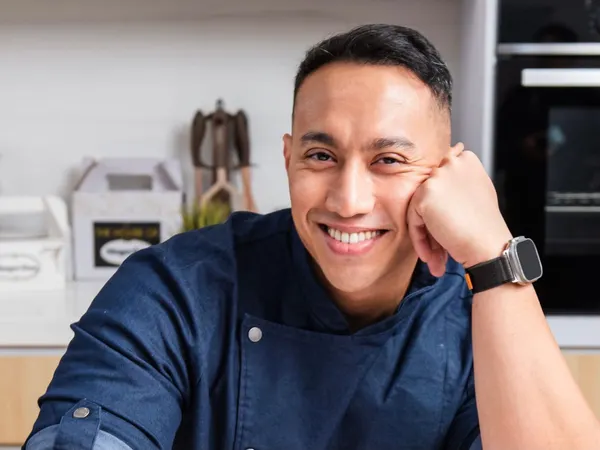
I came to meet Simon Maillard at Seed, his garden restaurant tucked a two-minute walk from the steps down to Bingin Beach, and the first thing you should know about him is that he was never supposed to be a chef. Not officially, anyway. There's no diploma, no stage under a big name, no line on a CV that explains how a French kid from Normandy ended up cooking Nusantara food in the Bukit. Which is exactly why I wanted to sit down with him.
A kid who couldn't choose
He's the second of eight. "My parents were quite busy," he tells me, which is the polite way of saying that with that many kids, dinner was going to be somebody's job. It became his. He started around ten, eleven (cake, pasta, the easy stuff) and by fourteen his mother told him to pick a direction.
"I cannot choose at 14 years old, my direction."
So he did normal high school instead, then went to university for history. It lasted three months. He'd sit in a lecture hall with six hundred other people listening to a man talk beautifully about the past, and every time he'd end up at the same question: okay, but what are you going to do with all of this? He didn't have an answer. So he quit. He was eighteen, maybe nineteen, and already deep into sailing and surfing, and the only thing he knew for sure was that he loved to cook for his friends and he wanted to see the world.
The man who bought the olive oil
His compromise was clever: a culinary business school, three years, each one requiring a training placement abroad. He used the placements to start traveling: the Caribbean, then Mauritius, then Bora Bora. And in Bora Bora he found the side door into the kitchen.
His first jobs were purchasing and logistics, then project management, opening resorts, the kind of build where you sit down with every department head six months before the doors open. His favourite meetings were always with the chef. "I need this rice from this area, I need the olive oil from this area," the chefs would tell him, and off he'd go to source it. For the St. Regis they'd flown in a team from the George V in Paris, a genuine palace; the pastry chef had trained under Pierre Hermé, one of the best in the world. So a month before opening, the chefs would arrive to test everything Simon had hunted down, and he'd be right there in the pastry section asking why this vanilla, why this chocolate, why these lobsters. "I want to understand why you asked me to buy this olive oil," he says. That was the whole education. He was tasting his way through it.
Gelato, boats, and a crash
The first business idea wasn't a restaurant. It was gelato. In French Polynesia the gelato was the one thing nobody had figured out, and there he was surrounded by the best vanilla in the world, mango, passion fruit. So he started small. At the same time he ran two charter boats, taking people island to island on what were basically expeditions. He was twenty-eight, twenty-nine, living the dream.
Then 2008 happened. The crash hit French Polynesia hard ("dramatic," he says twice) and the tourists simply vanished. He'd been lucky enough not to have sunk much money into the gelato yet, so he closed both businesses cleanly and flew back to France. Ten years in the Pacific, done.
Full on the first night
Before he opened anything, he gave himself a year to travel: his first time in Asia. Thailand, Burma, Cambodia, Indonesia, India. The goal wasn't restaurants. It was family kitchens. On a small Thai island he ate the same green papaya salad with squid every single day, ordering one more, then one more, trying to reverse-engineer the magic of it. "After three days, I was able to go in the kitchen to understand what was the secret of the papaya salad." He did the same in Kerala, spending weeks learning to grow pepper and cardamom, still his favourite spice. By the time he opened a restaurant, those flavours were already in him.
The restaurant was in a tiny village in the Alps: twelve seats, an old shuttered place he gutted in a month and rebuilt. He was in the kitchen alone, walking fifteen metres to the market twice a week, changing the menu constantly. "The first night, I was full," he says, still a little amazed. A Michelin-starred chef nearby became a regular, and then a mentor: he'd show up for dinner, Simon would set down a new dish, and the feedback would come. After two or three years, he was ready for something bigger. So he did the unthinkable: he closed a restaurant that was working, and wrote letters to chefs he admired.
The truffle dinner
One of those letters found its way to a friend who cooked for a high-end family. Two weeks later the ask came back: send menus for two weeks, Christmas and New Year, sixteen people. The family had been using a Michelin-starred chef. Simon sent his menus with zero expectation and, ten days later, got the job. "I was a bit scared," he admits: that particular fear of the self-taught person suddenly standing in front of very high standards. He spent ten days with a chef friend in Marseille learning not how to cook but how to plate, professionally. The family loved it. He became their private holiday chef for seven years.
That world turned out to be where his cooking really opened up. A private chef, he explains, usually works with no budget ceiling, which means no ceiling on the creativity either. The story he tells me from those years is the travel dinner. One of his clients announced a special evening: a travel-themed menu, every course built to incorporate one ingredient, truffle. Simon was not, at that point, a truffle specialist. There was a winemaker at the table, a full pairing, real money on the plates.
"I know that I cannot make any mistake this night."
So he researched, called friends, sent the menu to his mentor for notes, and then, because there's a window from the kitchen to the dining room, spent the entire service watching the big table, quietly panicking. The menu landed. He still laughs about the watching.
That's the thing that comes through with Simon: the food is French technique, but the art de vivre is all hospitality. A private chef isn't hiding in the back. "We are completely part of their holidays," he says. He's cooked on superyachts, worked the Cannes Film Festival two years running as head chef, built menus around whatever multicultural crew happened to be aboard. Every new kitchen, he says, made him more creative, not less.
Why Indonesia
I ask him why Bali, and he corrects me gently.
"It's not because of Bali. It's because of Indonesia."
Ten years in the Pacific taught him he loved the ocean but wanted more variety than one culture; Indonesia is, in his words, "17,000 islands, and all islands are different." He didn't want to keep arriving as a tourist. "I want to be part of the life."
So he saved the private-chef money, found land in 2019, and built Seed: his first proper restaurant with an actual team, after a career of cooking mostly alone. It opened in 2019. It closed roughly four months later, in March 2020, when the world did. "When you open a place, you build everything with all your love," he says, "and all your money." It stayed dark for about three years. He kept cooking privately through COVID for the same family that had launched him, and reopened Seed in 2023.
Bistro style, Nusantara soul
The reopened Seed is a looser, warmer thing. The first version, back in 2019, was probably too gastronomic for Bingin. Now Simon calls it bistro style, and he means it precisely. In a French bistro you eat boeuf bourguignon: cheap beef braised slowly in wine and aromatics until it melts off a spoon. So here he cooks rendang the same way: a humble cut, cooked his style until it collapses, except the rendang itself replaces the red wine.
"Instead of using the red wine, we use the rendang."
His tagline is French-Asian, and that's the honest math of it: completely Asian ingredients, filtered through a French hand, a little kaffir lime, a little citrus, curry used as a condiment rather than a headline.
Then there's the wine, which is where the Frenchman really shows. Once a month he runs a five-course menu paired with five French wines, and he's steering the list toward natural bottles and names close to his heart: Saint-Joseph, Crozes-Hermitage, small things from the Loire. Nusantara food, French wines. I love that as a sentence.
The one to beat
What does he want Seed to become? He answers by mapping the island. When you go to Ubud for Indonesian flavour, you go to the places everyone names; same in Seminyak.
"I want to be this place here in Bukit."
The reason someone comes to the peninsula and thinks, that's where you go to actually taste Indonesia. After three years rebuilding his team, he says the kitchen finally moves as one. You can hear that it matters to him more than any Michelin fantasy.
And yet he won't stay put. He's kept the private-chef life on purpose, because a restaurant menu can't change every day and his does: for the last year and a half he's also been cooking aboard the Kudanil Explorer, the 50-metre expedition yacht that reaches Raja Ampat and the deep parts of Flores, which he calls one of the best experiences in Indonesia, full stop. He's turned down two trips to Antarctica because he was too busy.
"Next time they call me for Antarctica, I will say yes."
And I believe him completely: this is a man whose whole life is a series of yeses said very fast, bag packed in two days.
He came to Indonesia to stop being a tourist. Somewhere between the papaya salad and the rendang, he pulled it off, and put a garden in Bingin where you can taste the entire journey.
Seed is a farm-to-table French-Asian restaurant by Chef Simon Maillard in Bingin, Uluwatu, a two-minute walk from Bingin Beach. Expect garden-grown herbs, wood-fired cooking, a bar of house-infused spirits, and a monthly French wine dinner. Open daily 7am to 11pm. Bingin Beach Road, Bingin, Uluwatu, Bali. Website: seedbingin.com · Instagram: @seed.bingin
Frequently Asked Questions
Who is Simon Maillard of Seed?
Simon Maillard is the self-taught French chef and owner of Seed in Bingin, Uluwatu. Born in Normandy and the second of eight children, he taught himself to cook through resort purchasing roles in the Pacific and family kitchens across Thailand and Kerala, then spent seven years as a private holiday chef before opening Seed.
What is Seed in Bingin?
Seed is a farm-to-table French-Asian restaurant a two-minute walk from Bingin Beach in Uluwatu, Bali. It serves Nusantara-rooted food through a French technique — including a rendang braised the way a bistro braises boeuf bourguignon — alongside garden-grown herbs, wood-fired cooking and a bar of house-infused spirits.
What does French-Asian food at Seed actually mean?
It means completely Asian ingredients filtered through a French hand, with touches of kaffir lime and citrus and curry used as a condiment rather than a headline. The signature example is Seed's rendang, cooked slowly until it collapses, using the rendang itself where a French braise would use red wine.
Does Seed host a wine dinner?
Yes — once a month Seed runs a five-course menu paired with five French wines, steering toward natural bottles and names like Saint-Joseph, Crozes-Hermitage and small Loire producers. It pairs Nusantara-influenced food with a French wine list.
Where is Seed and when is it open?
Seed is on Bingin Beach Road in Bingin, Uluwatu, Bali, a two-minute walk from Bingin Beach, and is open daily from 7am to 11pm. It first opened in 2019, closed during COVID, and reopened in 2023.