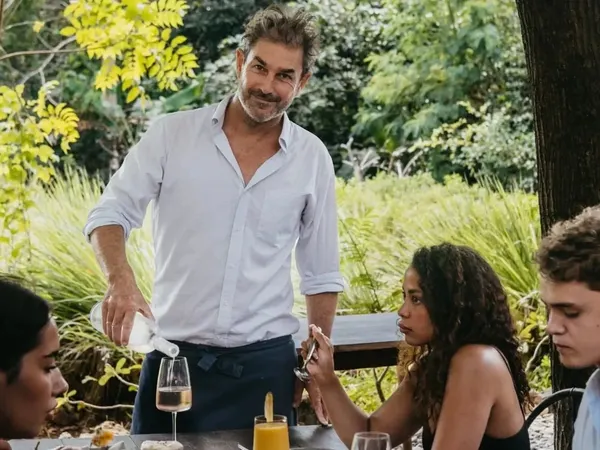
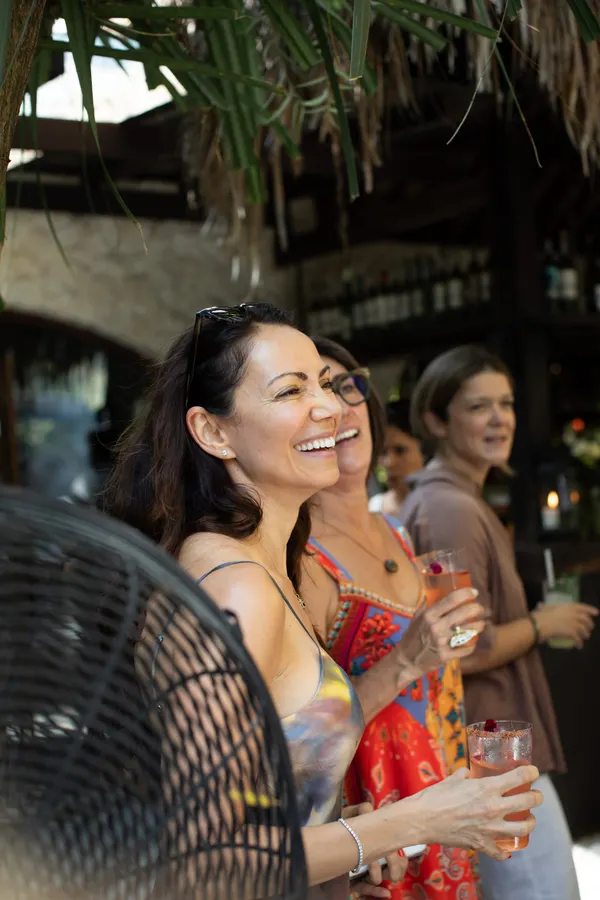
I came to meet Magda and Kasha for a catch-up, we're sitting in the garden of an old Balinese house in Pererenan, dogs wandering between the tables, somebody's laptop open two seats down, a painting the size of a door leaning against a wall that's original from the seventies. Magda keeps calling it "home." By the end of the afternoon, so do I.
A banner on a gate she kept driving past
Magda is from Poland and has lived in Bali for four years. She never planned to open a restaurant here. What she had was a road she kept driving down, and a banner on a gate that kept nagging at her. "I always wondering what is going on here, why this house is for rent all the time," she tells me. In August 2025 she finally sent a message. The house was available. She came to look.
"I saw the garden and I thought, wow, this is amazing, I have to do something with this."
She didn't have a plan so much as an instinct, and one firm rule. "I didn't want to destroy anything in this house. To keep everything." The ceilings were high, the walls begged for art, and the first idea that landed was a gallery. "The first thinking was like, okay, I will open the art gallery, and maybe I will put some coffee and cake," she says. "And from the coffee and cake, we have the restaurant." That's the whole origin story, really: a gallery that grew a café that grew a kitchen.
She has the receipts for it, too: a marketing and project-management background, a restaurant and two hotels back in Poland. "I am from the business world," she says. The art side she frames as passion, not talent. "I can't draw or paint, it's not my cup of tea. But the art, I love. I like beautiful curating." Fifteen years of travelling gave her the eye. "Let's connect all the dots and put here."
She couldn't do the art alone, so she called Kasha.
The one who grew up in the gallery
Kasha is the reason the walls make sense. "I grew up at my mom's gallery," she tells me. "My parents always connected business and art." She studied cultural studies and fine arts, art history, but her real heart is somewhere else. "Theater is something that I have the biggest heart for," she says. "I hope in the future I can create a proper theater group and run regular shows in Bali." For now that lives in the "dreams sphere," her words. But you can feel it shaping how she sees the space.
The two have known each other for years. So when Magda found the house, the call was short. Kasha said yes, let's do it. The renovation took two months, mostly a leaking roof and fresh paint, because the bones were good. "The ceiling is original, the stairs original, the wood we didn't touch," Magda says. They hung the paintings, put in the fans and the furniture, and opened at the end of November 2025. "I had this feeling that we open like five years ago," Magda laughs, "because so many things happened."
Untrusty artists and a room called Indoro
The art is not decoration here, it's for sale, and it's the point. Kasha's brief was to promote two kinds of artist at once: "the underground that nobody has ever seen," and the more established names she simply loves. At first, she admits, nobody believed it would work.
"All the artists were kind of untrusty, because the concept was weird: are we going to actually sell paintings, or are we trying to just get free display?"
They started with Indonesian artists and later opened the doors to international ones. Some pieces have already sold; others are waiting for their collectors. "This space would never be what it is now if not because of all the artists," she says.
What I didn't expect was how deliberately Indonesian the house is underneath the contemporary polish. It's a 30-year-old home from the Orde Baru era, Kasha explains: natural materials, a layout that's half modern, half traditional. They gathered antiques and artworks not just from Bali and Java but from Sumatra and NTT, and gave one room over entirely to Indonesian culture. They named it Indoro, the Indonesian Room. "Our goal was also to save the house," Magda says quietly.
"That's my canvas"
Ask them what Full House actually is and you get two answers that fit together. For Kasha it's a full-functioning gallery that refuses to stay one medium: dancers, performances, skateboarders threading through an exhibition. "It's really cross-industrial," she says. "The soul of this house, it will turn from art gallery to art theater. Maybe soon." When I ask her favourite part, she doesn't hesitate.
"I kind of feel that's my canvas that I can paint anything on."
Then she corrects herself, because a canvas needs an audience. "It's definitely a community thing, on many levels."
Magda's favourite part is simpler and it's the same thing: people.
"It's the name: it's full. Full of energy, full of feelings, full of food, full of art, full of people."
"We can exist only because the people are coming here," she says. The garden is a natural amphitheater, so of course they run movie nights in it. "It's not only about the movie, it's the experience. The space is so beautiful, this is our duties." Events sometimes run more than once a week, and yes, she knows how exhausting that is. "You think something's going to take an hour, it takes you three days."
They say yes to almost everything, which is how a 14-year-old from a local school ended up hosting a dog-adoption day in their garden, and how another student is bringing a silent art auction to fundraise for a refugee camp in Myanmar. "Who will do it? We can do it, so let's do it," Magda shrugs. There's a jazz collaboration in the works too, and a proper art auction with a Seminyak partner. "That's what happens when two creatives run a business," I tell them. You just keep attracting more creative people. They keep going, even when it's hard. Especially when it's hard.
And they don't over-plan any of it. "We never actually have a plan," Kasha says. "If you tell us today, let's do this event next week, we're like: yeah, okay, let's do it." What holds it all together isn't a business model, it's the way they both fell for this house and decided to fill it. "It's truly about the architecture of each place and its spirit," Kasha tells me, and you can feel exactly how much they mean it.
When I left, someone upstairs had turned a gallery room into their office like it was the most natural thing in the world. Which, at Full House, it is. You come for the coffee or the paintings, and somewhere between the garden and the dogs and the door that's always open, it stops feeling like a restaurant and starts feeling like a home two people loved enough to share.
Full House is a restaurant and art gallery inside a renovated 30-year-old Balinese villa in Pererenan, founded and run by Magda and her art-history partner Kasha. It opened at the end of November 2025 and blends breakfast, brunch and dinner with rotating exhibitions of Indonesian and international artists, movie nights, and community events in a garden that used to be a pool. Where: Jl. Pantai Pererenan No.129, Pererenan, Kec. Mengwi, Kabupaten Badung, Bali 80351. Open: daily from 8am (kitchen and gallery); later on event nights. Instagram: @fullhouse.bali · WhatsApp: +62 811-3882-771
Frequently Asked Questions
What is Full House in Bali?
Full House is a restaurant and art gallery inside a renovated 30-year-old Balinese villa in Pererenan. It blends breakfast, brunch and dinner with rotating exhibitions of Indonesian and international artists, movie nights, and community events, and opened at the end of November 2025.
Who founded Full House Pererenan?
Full House was founded by Magda, a Polish creative with a marketing, project-management and hospitality background, who spotted the villa's "for rent" banner and couldn't let it go. She runs it with Kasha, her art-history partner, who grew up in her mother's gallery and curates the space.
Where is Full House and what are the opening hours?
Full House is at Jl. Pantai Pererenan No.129, Pererenan, Kec. Mengwi, Kabupaten Badung, Bali 80351. It is open daily from 8am for the kitchen and gallery, and stays open later on event nights.
Can you buy the art on display at Full House?
Yes — the artwork is for sale, not just decoration, and spans both underground artists and more established names, starting with Indonesian artists and later international ones. The villa also has a dedicated room called Indoro, the Indonesian Room, filled with antiques and artworks from Bali, Java, Sumatra and NTT.
What events does Full House host?
Full House runs movie nights in its garden — a former pool that now works as a natural amphitheater — along with community events that can happen more than once a week. Past and upcoming events include dog-adoption days, charity art auctions and jazz collaborations.