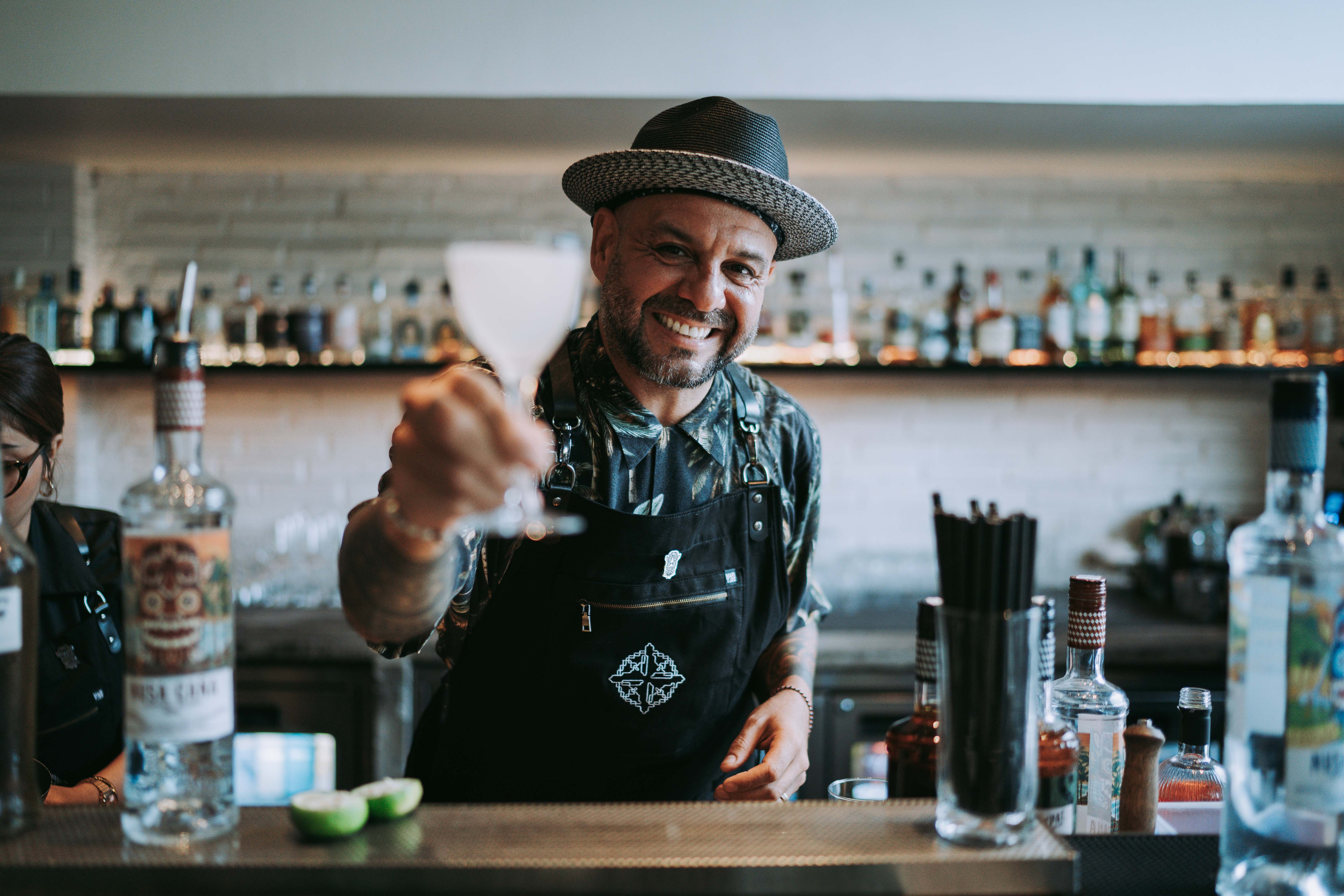
I had the chance to spend time with Dré at Chop House, Canggu, Bali on one rainy evening, where he and his protégés were serving a signature cocktail menu featuring Nusa Cana's selection of rums for the night. And when I walked through the Masonry door at dusk, turning my head to the right, I can already see him behind the bar, preparing cocktails and doing some photoshoots before the evening began.
I was offered one of the drinks from the signature menu, a rum coconut negroni. As a coconut lover, it was one of the best cocktails I've ever had. Refreshing, sweet, and loudly tropical. Didn't match the thick, damp Bali air that night.
View on Instagram
Then we moved to Chop House, tucked in the back of Masonry, where the music was loud and everyone was deep in conversation. And so were we, talking about how the cocktail industry has changed over the past 34 years, and why Dré believes the classic cocktail capitals of the world are losing ground to the underdogs, driven by creativity and the hunger that the old champs have started to forget.
From Following His Mother to Work, to 34 Years Behind the Bar, The Making of Dré Masso
Dré Masso is a Londoner with Latin roots. All of his family are from Colombia, he was the first generation born outside of it, and spent much of his early life in the places where his mother worked. She was a single mother who held six or seven jobs at once. From about four or five years old, Dré was absorbing the environment of restaurants and bars.
"She was a nanny, she was a cleaner, she was a chef at the weekends. Often I would go with her. I was familiar with that environment, restaurants, chefs, bartenders, managers. The smells and the noises from a very young age. I'd say from probably four or five years old, I'd get taken to those establishments.”
By fifteen, he was working at the private leisure club where his mother was employed. By eighteen, in 1993, he was making cocktails professionally, the start of what is now his 34th year in the industry. Though exposed to the kitchen world early on as well, the path to bartending rather than cooking wasn't a deliberate choice so much as a social one. College friends worked in bars and showed him how it was, a lot of other people from college would also come in, say hi, and enjoy their night. It was fun and lively. Being on the hospitality side of that felt right for him.
Chemist's Skill, Chef's Tastebuds, Anthropologist's Brain
His real education in bartending started at The Atlantic Bar & Grill in London, around 1995. It was also one of London's most celebrated rooms at the time, where celebrities dined and bartenders from across the world would come and hang out.
"What was different about The Atlantic is that they trained their bartenders in a very in-depth way. I worked in other bars, but none that taught you about the history of drinks, the production of alcohol, or the philosophy behind the bar. The Atlantic, for me, was a very special place.”
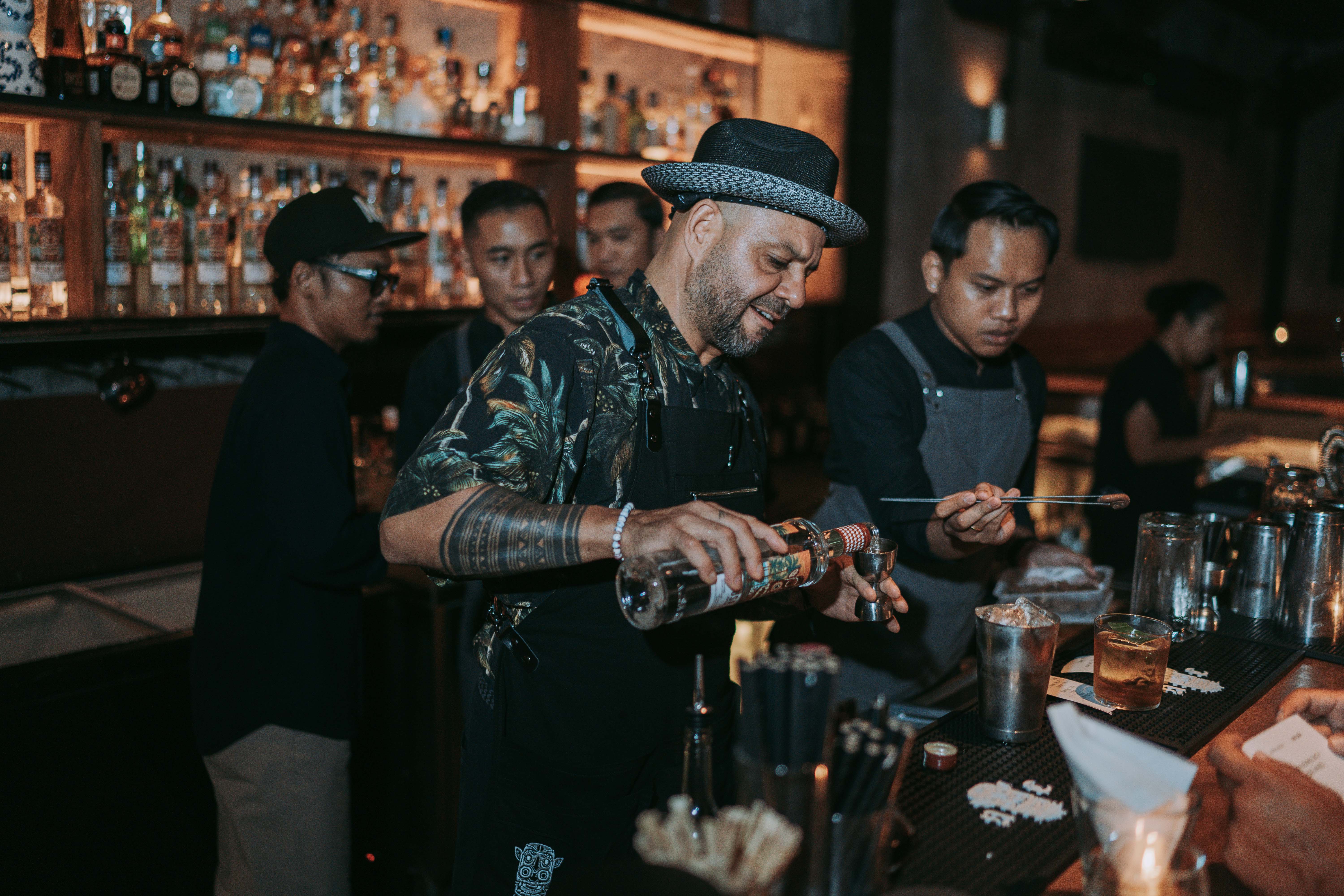
He spent four years there, moving from being a bartender to supervisor to manager, eventually becoming part of the opening team, brought in when a new venue was launching, to shape its concept, its drinks program, its staff.
That last part matters. Because for Dré, while chefs go to culinary school, bartenders, nine times out of ten, fall into the job and learn from whoever is standing next to them. The craft is passed person to person, which means it is only as good as the person doing the passing. Dré has spent a significant part of his career trying to close that gap, dedicating himself to the world of bartending education. But that, he is quick to say, is just one of many things.
"I would be part of the concept creation of the drinks program, the training of the staff. And that's when I really started passing that educational thing. You do that anyway in the bar, when someone new comes along, you're inevitably showing them how to make the best version of a drink, or how you perceive that to be. And that's just very common.”
The book is another. His latest, Drinks by Dré: Classic Cocktails at Home, updated in 2024, came from something every bartender has done: the napkin recipe. A guest leans over and asks how to make a drink at home, and you scribble the ingredients and tips down. Dré has done that thousands of times, and the book is those napkins, made serious.
From Palate Changes to Cocktail Capitals Shifting, How Cocktail Culture Has Changed in 34 Years
Dré argues, though he is quick to note it's a generalization, that the world of cocktails has changed throughout the decades.
In the 1970s and 80s, a fresh strawberry behind a bar was unusual. Pre-made syrups were the norm. Drinks were, as Dré puts it, two-dimensional, sweet, sticky, and largely unchallenging. Now, people are more comfortable with bitter, drier, and more complex flavors than they were thirty years ago. The Negroni is the proof: in the 1990s, suggesting one to a guest was a gamble. Today it is one of the most popular cocktails in the world.
Much of that evolution, Dré argues, is owed to the internet. In the late 90s, there was barely any literature on cocktail craft, information was scarce and local. The internet dismantled that entirely. The result is visible in places like Bali, where this conversation is taking place.
London, which held the title of cocktail capital in the 90s, no longer does so unchallenged. Everywhere else has caught up, and in many ways, he says, London is behind. The reason, for Dré, comes down largely to the hunger of the underdog. Asia, Bali, Jakarta, Hong Kong, Singapore, Bangkok, Seoul, Tokyo, has transformed itself into a collection of cocktail destinations, driven by the desire to create, initiate, and push harder than the cities that were always assumed to be ahead.
Back in the UK, the picture is less optimistic. More bars are closing than opening. The industry there is still working to find its footing again, while globally, cocktail culture is stronger than ever.
"Currently we're seeing a situation in the UK which isn't very positive. More bars are closing than opening, high rent, high taxes, electricity, water, gas, all skyrocketed. We lost a lot of our workforce during Brexit. Then COVID came and a lot of people pivoted to something else entirely and never came back. We were left with a harder situation to build a business, and without our talented staff. What followed was a younger generation less concerned about passion and training, wanting more pay but wanting to work less. That's just a personal note of what I'm seeing from where I'm from.”
One thing helping that global strength, Dré thinks, is the birth of World's 50 Best Bars program, divisive in some quarters, but undeniably effective as a connector between bars and guests. People now travel specifically to visit highly ranked bars. There is an entire tourism built around eating and drinking, which Dré finds genuinely fascinating.
View on Instagram
From Gen Z Not Going Out to Please Don't Put Onions in My Cocktail, The Hot Takes
There is a global discourse that Gen Z is stepping back from alcohol and drinking less, the evidence, Dré says, keeps getting stronger. The reasons are multiple: health consciousness, economic pressure, the rise of other recreational choices, and the habits formed during COVID, when cheaper spirits moved into homes and people discovered they could drink in the comfort of their own space. Coming out of the pandemic, a lot of people had also spent so much time at home during lockdown that they lost the habit of going out at all.
"Going out and drinking is more expensive than ever. In the UK, that age bracket, more people out of education, out of work, who simply cannot afford to keep up that luxury. And COVID introduced the opportunity to drink and eat better at home.”
On the question of "alcohol is just alcohol, give me the cheapest one," Dré's response is immediate: it's a shame. The spectrum between a spirit made without care, using the cheapest possible ingredients, and one made with genuine craft and integrity is vast. That difference shows up in taste and in how a person feels afterward. His advice is always the same, reach for something well-made, something produced with the finest ingredients. The guest, he believes, owes it to themselves to take the time to understand why it matters.
On hospitality, the human side of the bar experience, Dré is pointed. One of his consistent frustrations, not exclusive to the UK but particularly visible there through his experience, is walking into a bar and being met with nothing. No acknowledgement, no recognition, no guidance. Guests are left searching for a menu, unsure where to stand. He notes, almost as a counterweight, that the Balinese, one of the underdog cities he mentioned, are naturally warm. Guests are welcomed in a way that feels seen and considered.
"It's not just in the UK, I pick that up everywhere. But part of the UK's reconnection, its reinvention, comes down to training and education. I hope the future is a lot brighter through how we pass that information and train people in hospitality, so we can give our guests the best service.”
And then there is the onion problem. As palates have evolved toward savory, complex, and bitter flavors, bars have followed, incorporating seaweed/nori, mushrooms, and onions into cocktails. Dré has tried many of these drinks in the past year. His concern is not with the concept, but with execution.
"I've tried a lot of drinks in the last year that had either mushrooms or onions in them. I wouldn't be saying it if I hadn't had so many experiences of tasting cocktails with either mushrooms or onions that have left a sour note, a sour taste in my palate. People see these trends on the internet and naturally think, this is what we should be doing, we've got to have a cocktail that has a really funky, sour, savoury note. But don't do it if it doesn't work and it doesn't taste delicious.”
The Underdogs Are Doing It Better, Where the World Drinks Best Right Now
Ask Dré where the cocktail capital of the world is and he'll tell you his answer tends to change depending on where he's just been. Right now, it's Australia. Melbourne and Sydney specifically, cities where hospitality is done with consistency, knowledgeable staff, exquisite service, forward-thinking cocktails. On a recent trip across both cities, bar after bar delivered. Melbourne and Sydney, in his current read, are flying the flag.
But he raves about Southeast Asia too. The progress across the region over the last fifteen years has been, for Dré, one of the most exciting developments the industry has produced. Bangkok impressed him on his last visit, bars that left him genuinely enthusiastic. Jakarta is also really cool right now. Cities that were once overlooked have built scenes with real identity, real craft, and real hunger to be the best.
Afterword
The cities that were never assumed to be ahead built their scenes with a hunger to create more, push harder, and cater better, and that is exactly what the industry is supposed to be about. That is what makes the underdogs further ahead than the old, traditional capitals: the creativity and the hospitality behind them. That is what separates a well-crafted cocktail, the atmosphere, the experience, the integrity, from a cheap pour at home. And after 34 years, that is still what Dré is looking for every time he walks into a bar, and what he thinks will push the next generation to carry this culture forward.
Feature by Nadila Amani. Interview with Dré Masso at Chop House (Masonry Back Room), Saturday 28 February 2026.