The Rumor That Started Everything
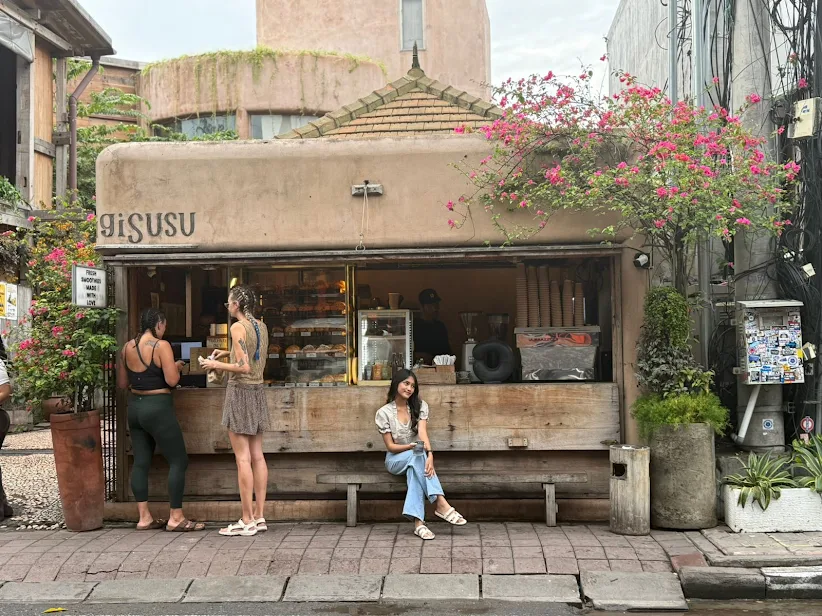
On TikTok and Instagram, there are hundreds of pieces of content about them, and yet half of them are people talking about why Gigi Susu is so popular, coming from both locals and people on social media. This creates a discourse that makes people want to comment, debate, and weigh in. And yet they keep jumping on the bandwagon anyway: coming to Canggu, visiting Gigi Susu, and taking pictures in front of their stall with their drinks.
View on Instagram
Then there’s the rumor that arguably accelerated all of it: that Gigi Susu is owned by Gavin Casalegno, the American actor who portrays Jeremiah Fisher in Amazon Prime’s The Summer I Turned Pretty. The rumor was born from a single picture of him in front of the takeaway stall, and we don’t even know if it was actually him or an AI-generated image.
Three TikTok trends were born from the mix of online conversations, people using a popular Jeremiah sound from the series, “you’re not going to Bali if you haven’t been to Gigi Susu,” and “this is where all the South Jakartans take their OOTD pictures.” People started sharing on TikTok that they even wake up at dawn to be the first customer, some staying near the area solely to visit Gigi Susu.
The rumor has since been debunked, Gigi Susu is Indonesian-owned to this day. But the damage, or rather, the gift, was already done.
From a Humble Takeaway Stall
Yesy, a house staff member who has worked there since early 2023, told us that the virality kicked in that same year, when just a year prior, in 2022, they were nothing more than a mini takeaway stall. They now operate two distinct areas: the original takeaway stall and a full dine-in café beside it, and are still expanding further, expected to be finished this year. The menu has grown with it, from breakfast and brunch only to a full day of service from breakfast to dinner.
The reach isn't limited to Jakarta's crowd either. Gigi Susu has found its way onto Douyin, bringing in a wave of Chinese tourists who add it to their Bali itinerary before they've even booked their flights.
"Other than people from Jakarta, we see a lot of Chinese tourists coming here as well, we went viral on Douyin too,"
said Yesy.
The Loop That Never Runs Out
This “why are they even popular?” phenomenon is actually a well-documented social psychology concept, sometimes called social proof on steroids. Virality becomes self-sustaining because being seen there becomes the product. The place stops being just a café and starts functioning as social currency. Gigi Susu is a compelling case study because they didn’t seem to manufacture it, no paid influencer campaigns, no orchestrated launches like many Canggu spots do. And if they did, it felt organic regardless, which made the loop stickier.
What they’ve built, perhaps without a blueprint, is a perpetual virality machine: UGC feeds word of mouth, word of mouth triggers FOMO, FOMO generates more UGC, and the cycle repeats.
This loop is also uniquely sustained by where Gigi Susu is located. Canggu has one of the highest concentrations of tourists, short-stay digital nomads, and long-stay expats in Southeast Asia. Unlike a fixed neighborhood in a city where everyone has already been, this demographic cauldron allows Canggu to receive a new wave of first-timers every week. The loop never runs out of new participants. And when those new participants stay and make a café their regular office or Sunday spot, they become repeat customers who bring people they know as well. Gigi Susu benefits from both tourists and long-stay expats simultaneously.
Rise to Meet the Hype
But here’s where it gets more interesting than a standard virality story. The real question isn’t how they went viral, it’s whether genuine hospitality can survive virality. That’s the knife’s edge Gigi Susu has been walking, and for the past three years, they haven’t fallen.
When the trend hoppers arrive, and they do, in waves, they’re met with pretty, welcoming architecture, genuinely warm staff, and food that stands up to its own hype. The almond croissant alone is easily 2-3 times the size of what you’d find at comparable cafés in the area, and their packaging is cute. The experience, relatively speaking, meets the hype.
Even those who say that it’s nothing special on social media end up feeding the loop, again. Creating conversation and exposing more people to FOMO. Is it actually just okay? Is it actually good? Let me try it and see for myself. That impulse, repeated thousands of times, is the organic viral machine running exactly as it should.
Maybe the Point Is to Don’t Try, Or at Least Not Look Like It
Most places that go viral begin performing too much. They franchise too fast, commercialize too soon, and optimize for content rather than the experience. Gigi Susu, at least for now, seems to have done the opposite, continuing to quietly be themselves while the internet argued about whether they deserved the attention. And perhaps that is the whole answer: they never tried to ride the bandwagon or look like they were. They simply let the conversation bring in their customers and welcomed them normally.