You almost miss the turn. The lane into La Réserve 1785 is cobblestone, which is already strange for Pererenan, and by the time you reach the door the scooters and the construction dust have fallen away and you've somehow crossed into a French garden. A fountain in the middle. Gravel that crunches in a way tile never does. Herbs in the courtyard, a Renaissance painting against a deep blue wall, a wall of books. You know you're in Bali. Nothing around you is saying so.
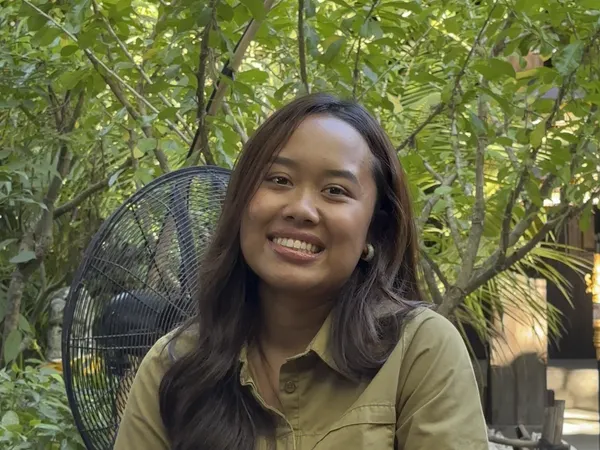
The woman behind it is Laure Juhen, and she has spent a lifetime giving spaces a soul. Half French, half Syrian, born in France and gone by three months old, she was raised across Chad, Sudan, Saudi Arabia, Mexico, Guatemala and Chile, moving roughly every two years. Her father calls her "the African chameleon." Each place left her a value rather than a souvenir: humility from Africa, a distaste for trends from Egypt, restraint from Japan ("what is beautiful is what is not shown"), and from her Syrian mother, hospitality as something sacred.
All of that poured into one hotel. La Réserve 1785 is her homage to Henriette Reboul: the 97-year-old woman Laure greeted every morning in Aix-en-Provence, who turned out to be the last courtesan of Provence, a friend of Picasso, keeper of a small drawing signed "To my little Henriette, Cézanne." Laure built the tribute almost single-handedly: over 1,700 drawings across two years, a 700-crystal chandelier, a bespoke perfume six months in the making, a decorative frame so exacting it required buying four trees and now weighs over a ton. "It's very easy to make a beautiful place," she says. "It's so difficult to give a soul to a space." Her definition of the word most hotels overuse: "For me, luxury is not about giving more, having more. It's about feeling more."
So when a woman who builds beauty for a living tells you where she goes when she travels, you listen. Here, in her own words, are the three places in the world she loves most.
Singita, Africa
"The lodges are the most amazing places in the world. You feel it's another landscape. The pure definition of luxury."
Singita is a collection of safari lodges founded in 1993, when Luke Bailes opened Ebony Lodge on land in South Africa's Sabi Sand that his grandfather had first bought back in 1925. What began as one lodge is now nineteen lodges, camps and exclusive-use villas across six regions in four countries: Sabi Sand and Kruger in South Africa, the Serengeti in Tanzania, the edge of Volcanoes National Park in Rwanda, and the Malilangwe reserve in Zimbabwe. The name is Shangaan for "place of miracles," and the whole enterprise runs on a hundred-year promise: to protect roughly a million acres of African wilderness for future generations, with conservation as the reason for being rather than the marketing.
For Laure, who first learned humility in Africa ("you have this connection to nature, it's greater than you"), the appeal is the total transportation. This is not a hotel you check into so much as a landscape you're dropped inside, which is exactly her measure of the real thing. It's the same instinct that made her refuse an infinity pool at home in favour of something modelled on Tirta Empul, the Balinese water temple: luxury as immersion, not display.
Aman Tokyo, Japan
"In one of the busiest cities of the world, they made a silent sanctuary. They manage an incredible thing."
Aman Tokyo opened in 2014 as the brand's first urban hotel, occupying the top six floors (levels 33 to 38) of The Otemachi Tower in the city's financial district. It was designed by the late Kerry Hill (his sixth Aman) and it translates the ryokan into the sky: classic Japanese materials of camphor wood, washi paper and stone, worked into a play of shadow and light. The centrepiece is a lobby that soars nearly thirty metres, a lantern of stretched washi framed in shoji rising six floors through the middle of the building. There are 84 rooms and suites, a garden in the air, and a thirty-metre pool that looks out past Shinjuku to Mount Fuji on a clear day.
This is the pick that most clearly rhymes with Laure's own taste. Japan taught her restraint, the idea that beauty lives in what isn't shown, and Aman Tokyo is that philosophy built at scale: stillness manufactured in the middle of the loudest city on earth. "They manage an incredible thing," she says, and coming from someone who agonised for six months over a single perfume so her guests would "remember something," the compliment is precisely calibrated.
Villa d'Este, Lake Como
"Definitely one of my favourites: Villa d'Este, near Como Lake. It's a pure jewel."
Villa d'Este sits on the shore of Lake Como at Cernobbio, in northern Italy. It began life as the Villa del Garovo, a Renaissance residence built between 1565 and 1570 for Cardinal Tolomeo Gallio and designed by Pellegrino Tibaldi. Its later owners read like a European history book (it was Caroline of Brunswick, Princess of Wales, who renamed it Villa d'Este in homage to her lineage) and in 1873 it became the international luxury hotel it remains today, its Renaissance gardens and lakeside terraces still drawing the world's most seasoned travellers.
You can see why it lands with Laure. It is the art de vivre she chases: timeless rather than trendy, the value Egypt taught her ("thousands of years after the pyramids, we still have millions of people coming; I like timeless products"). A place that has been beautiful for four and a half centuries and never had to shout about it is, more or less, the argument La Réserve 1785 is trying to make in miniature. A pure jewel, in her words, and she does not hand the word out lightly.
Laure Juhen is the French-Syrian architect behind La Réserve 1785, the adults-only boutique hotel she designed and built in Pererenan, Canggu: her homage to a grandmother she chose, told through 1,700 drawings and a garden that turns, halfway through, from Provence into Bali. lareservebali.com
Frequently Asked Questions
Who is Laure Juhen, the founder of La Réserve 1785?
Laure Juhen is a French-Syrian architect and the founder of La Réserve 1785, an adults-only boutique hotel in Pererenan, Canggu, Bali. Raised across Africa, the Middle East and Latin America, she designed and built it almost single-handedly over two years as a tribute to Henriette Reboul, the woman she calls her grandmother.
What are Laure Juhen's three favourite hotels in the world?
Her three favourites are Singita's safari lodges in Africa, Aman Tokyo in Japan, and Villa d'Este on Lake Como in Italy. Her taste runs to immersion and timelessness over spectacle — places that make you feel more rather than simply offer more.
Where are Singita's safari lodges located?
Singita is a conservation-led safari company founded in 1993 that now runs nineteen lodges, camps and villas across four countries. You'll find them in South Africa's Sabi Sand and Kruger, Tanzania's Serengeti, Rwanda near Volcanoes National Park, and Zimbabwe's Malilangwe reserve.
What makes Aman Tokyo special?
Aman Tokyo opened in 2014 as the brand's first urban hotel, occupying the top six floors of The Otemachi Tower and designed by Kerry Hill. It's prized for turning a skyscraper into a serene, ryokan-inspired sanctuary, with a soaring washi-paper lantern lobby and a thirty-metre pool with views toward Mount Fuji.
What is the history of Villa d'Este on Lake Como?
Villa d'Este in Cernobbio was built between 1565 and 1570 for Cardinal Tolomeo Gallio and became a luxury hotel in 1873. Renamed by Caroline of Brunswick, Princess of Wales, it remains one of the world's most celebrated grand hotels, known for its Renaissance gardens overlooking the lake.